Desecting Young's Inequality!
Young's Inequality
Motivation
This semester i’ve applied for the course “Introduction to Topology”. As always proofs built upon other proofs. I will desect some inequalities and their proofs, which are needed for topology. I begin with Young’s Inequality which can be used to proof the Hoelder Inequality. The Minkowski Inequality depends on the latter and is used to show that the euclidian norm is a metric.
Definition
Let $f: [0,\infty[ \rightarrow [0,\infty[$ be strictly monotonically increasing and unlimited with $f(0)=0$. This implies that the function is bijective (injective + surjective) and the inverse function $f^{-1}$ is defined. If the following property holds true $a,b \gt 0 $ Young’s Inequality is: \begin{eqnarray}\label{eq:young} ab \leq \int_0^a f(x) dx + \int_0^b f^{-1}(y) dy \end{eqnarray}
Proof
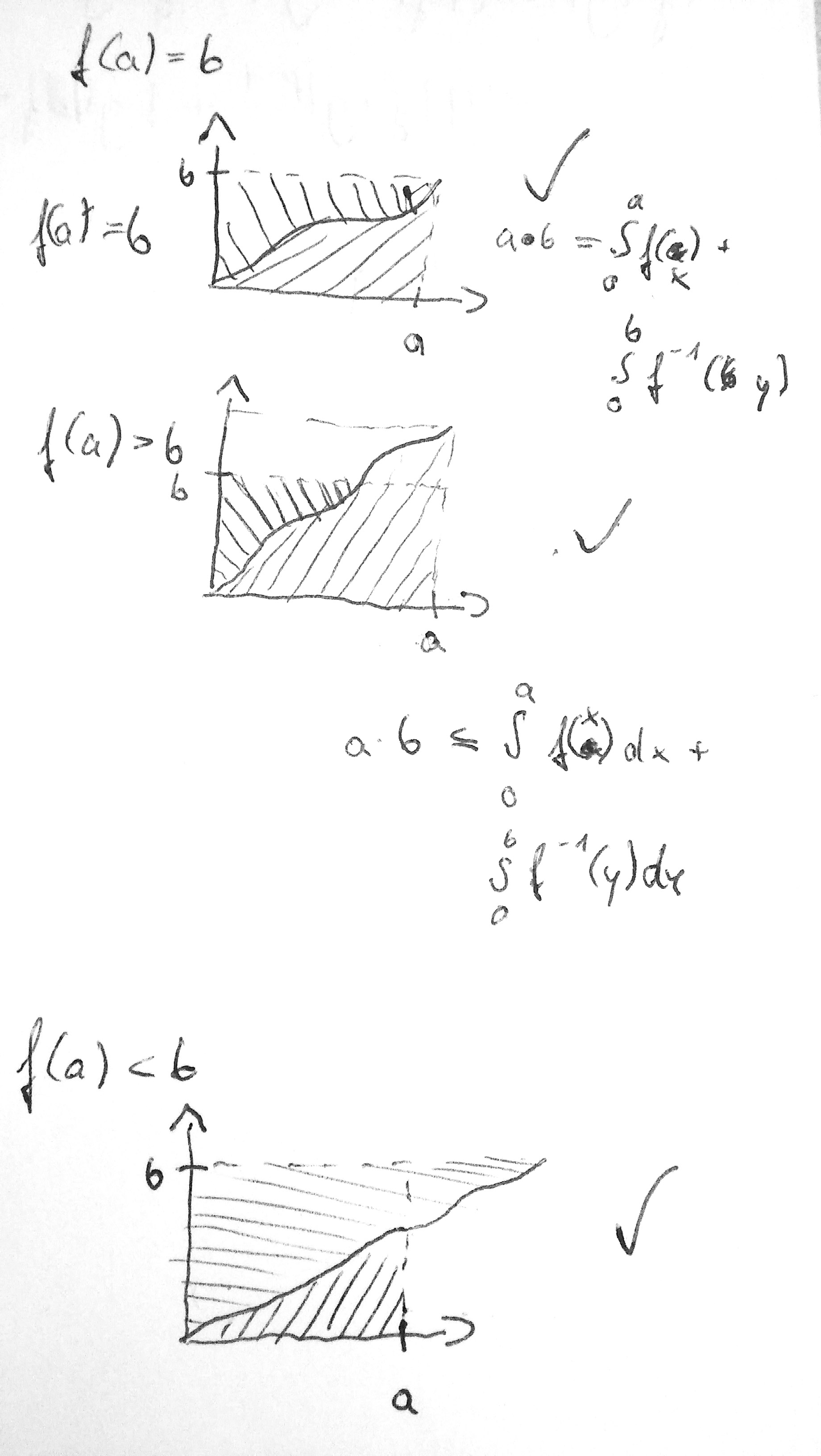
The next figure depicts how this can be proven visually. For $f(a) > b$ and $f(a) < b$ adding the area under the curves together always results in a bigger area than that of the rectangle $ab$. If $f(a)=b$ the area is exactly equal to the rectangle area enclosed by a and b.
First we need to describe the inverse function $f^{-1}(y)$ by x. So substitute $f^{-1}(y)=x$ in the second integral of above eq. Additionally mind $\frac{dy}{dx}= f'(x)$ and to adjust the interval of the integral.
\begin{eqnarray}\label{eq:finverse} \int_0^b f^{-1}(y) dy = \int_0^{f^{-1}(b)} x f’(x) dx \end{eqnarray}
Next follow it up with partial integration: $u = x, v' = f'(x), u' = 1, v = f(x)$. \begin{eqnarray} \label{eq:fy} \int uv' = uv | - \int u'v = x*f(x)|_0^{f^{-1}(b)} - \int_0^{f^{-1}(b)} 1*f(x) dx = f^{-1}(b)*b - \int_0^{f^{-1}(b)} f(x) dx \end{eqnarray} This allows us to rewrite eq. \ref{eq:young} by putting in eq. \ref{eq:fy} and fusing the integrals: \begin{eqnarray} ab \leq \int_0^a f(x) dx + f^{-1}(b)*b - \int_0^{f^{-1}(b)} f(x) dx = \int_{f^{-1}(b)}^a f(x) dx + f^{-1}(b)*b \end{eqnarray}
For $f(a)=b$ the area is exactly $ab$. The integral becomes 0, $f^{-1}(b)=a$ leaves us with $ab$.
For $f(a) > b$ we can take the integral from $f^{-1}(b)$ to $a$ and estimate the rest of the area that is in $ab$ by $\int_{f^{-1}(b)}^a f(x) dx = \int_{f^{-1}(b)}^a b dx = (a - f^{-1}(b)) b $. Note that $f^{-1}(b)$ is smaller than $a$, so the area is of course positive. Because b is strictly monotonically increasing we can estimate that the area is even bigger than the proposed integral:
\begin{eqnarray} ab = (a - f^{-1}(b)) b + f^{-1}(b)*b \lt \int_{f^{-1}(b)}^a f(x) dx + f^{-1}(b)*b. \end{eqnarray} Analog follows $f(a) < b$ by \begin{eqnarray} ab = -b(f^{-1}(b)-a) + f^{-1}(b)*b \lt - \int_a^{f^{-1}(b)} f(x) dx + f^{-1}(b)*b = \int_{f^{-1}(b)}^a f(x) dx + f^{-1}(b)*b. \end{eqnarray}